

Yes, you can snorkel with contact lenses — and millions of contact-wearers do every year. The answer isn't a flat prohibition; it's a conditional yes that depends on the type of lenses you wear, how well your mask fits, and what you do when water enters the mask. This guide explains the actual mechanics of why some contact types are safer than others underwater, the infection risk most articles understate, and four alternatives for people who'd rather not put their lenses at risk at all.

Can You Snorkel With Contact Lenses?
Snorkeling is considerably safer for contact wearers than scuba diving, for one key reason: depth. Snorkeling stays at the surface. Scuba diving involves significant pressure changes as you descend, which create specific gas-exchange problems between the lens and the cornea that don't apply at the surface.
That said, snorkeling with contacts isn't consequence-free. The critical variable is mask seal. Your contacts should never contact ocean water — the mask keeps them separate, but only if it maintains a watertight seal against your face throughout the session. The moment water enters the mask, you have ocean water touching your lenses. Close your eyes before clearing the mask, never open your eyes underwater without the mask on, and the risk stays manageable. If the mask leaks frequently, or if you're clearing it repeatedly with your eyes open, the risk profile changes.
Why Soft Lenses Are Significantly Safer Than Hard Lenses for Snorkeling
Most contact-wearers today use soft lenses, but the distinction matters enough to understand the mechanism:
Hard lenses (rigid gas permeable, or RGP). Hard lenses are smaller diameter than soft lenses and don't allow gases to pass through the lens material efficiently. During scuba diving, as nitrogen absorbed by the eye slowly escapes, it can form tiny bubbles between the hard lens and the cornea — causing blurred vision when the diver surfaces and removes the mask. At snorkeling depths this pressure effect is less pronounced, but hard lenses still create two problems: they're more likely to float out when clearing water from the mask (smaller diameter means less surface contact with the eye), and they reduce oxygen permeability to the cornea, potentially causing dry-eye discomfort during extended sessions.
Soft lenses. Soft lenses are gas-permeable, allowing oxygen and other gases to move through the lens material. They're larger in diameter, conforming more fully to the eye surface, which means they're far less likely to dislodge when water enters the mask or when you blink in wet conditions. They also maintain better corneal moisture over the course of a snorkel session.
If you wear hard (RGP) lenses, the recommendation from eye care professionals is to either switch to soft lenses for the trip or use one of the alternative solutions described later in this article.
What's the Biggest Risk of Snorkeling With Contacts?
The infection risk is real, and the most dangerous organism is not bacteria — it's a parasite called Acanthamoeba. This microscopic organism lives in fresh water, swimming pools, and occasionally seawater, and it has the ability to get trapped under a contact lens and adhere to the corneal surface. The resulting infection, Acanthamoeba keratitis, is difficult to treat and in serious cases causes permanent vision impairment.
Ocean water is generally lower risk for Acanthamoeba than pool water or lakes, but "lower risk" is not zero risk. The practical implication: if ocean water contacts your lenses, dispose of soft daily lenses immediately after the session. For monthly or bi-weekly reusable lenses, remove them, disinfect thoroughly with hydrogen peroxide solution (not multi-purpose solution alone), and monitor for any symptoms — redness, light sensitivity, unusual pain — in the days following. Any symptoms warrant urgent eye care evaluation, not a wait-and-see approach.
Beyond Acanthamoeba, saltwater is hypertonic — it draws moisture out of the contact lens, causing it to tighten against the cornea and increasing discomfort and potential lens adhesion. If you notice your contacts feeling tighter or more uncomfortable during a snorkel session, exit the water, remove the lenses, and allow the eye to recover before reinserting.
What If Water Gets in Your Mask? The Protocol
Mask flooding happens. A wave catches you, you laugh at something, the seal breaks momentarily. Here's the correct protocol for contact wearers:
- Close your eyes immediately when you feel water entering the mask. This is the most important habit to practice before you need it. Eyes open + ocean water + contacts = high risk for the problems described above.
- Clear the mask with eyes closed. Exhale through your nose while pressing the top of the mask frame lightly against your forehead — water drains from the bottom seal. You don't need to see to do this; it's a tactile skill that becomes automatic with practice.
- After clearing, check before opening eyes. Run your finger along the bottom seal to confirm water is cleared, then open your eyes slowly. If the mask is clear, proceed. If there's still water, close and repeat.
- Never rub your eyes in or after the water. Wet, sandy hands pressing on a contact lens can trap particulate matter under the lens against the cornea, causing immediate pain and potentially scratching the corneal surface.
At the end of the session: remove the lenses in a clean environment (not on a boat deck where salt water spray is present), store or dispose of them properly, and flush your eyes with sterile saline if available.

What Type of Contacts Work Best for Snorkeling?
Daily disposable soft lenses are the optimal choice for snorkeling specifically. The reasoning is simple: you use them once, they go in the trash at the end of the session, and any contamination they absorbed from the water goes with them. There's no reprocessing, no risk of inadequate disinfection, and no carrying contaminated lenses through the rest of your trip. If you lose one in the water, you've lost a lens worth less than a dollar — not a monthly lens worth twenty times that.
If you're a monthly or bi-weekly lens wearer and don't want to buy a box of dailies just for the trip, the same lenses can be worn — but hydrogen peroxide disinfection after each ocean session is the appropriate standard, not multi-purpose solution alone. Hydrogen peroxide systems kill a broader spectrum of organisms including Acanthamoeba cysts; standard "no-rub" multi-purpose solutions do not.
Extended wear lenses (approved for overnight use) have higher oxygen permeability and could theoretically offer some advantage in snorkeling conditions, but the infection risk from wearing any lens in ocean water remains the same regardless of oxygen permeability. There's no meaningful benefit from extended-wear-specific lenses for snorkeling purposes.
What Are the Alternatives to Wearing Contacts While Snorkeling?
If you'd rather not take any lens risk at all, four alternatives exist at different price and convenience points:
Prescription snorkel masks. Masks with custom lenses matching your exact prescription are available from specialty dive shops and online opticals. The process involves providing your prescription to the mask manufacturer or optician, who installs corrective lenses into the mask frame. Quality varies significantly — a precisely fitted prescription in a quality mask is genuinely excellent; a poorly executed one can cause eye fatigue. Starting cost is around $150–200 for basic prescriptions, rising with strong prescriptions or bifocal requirements. For anyone who snorkels more than a few times a year, the one-time cost is frequently worth eliminating contact lens logistics entirely.
Off-the-shelf corrective masks. Major snorkel manufacturers sell masks with pre-made corrective lenses in common prescription ranges, typically covering nearsightedness from -1.0 to -8.0 diopters in half-diopter or full-diopter increments. These are not your exact prescription, but for mild to moderate myopia, the close approximation is often sufficient for snorkeling distances. Cost is $30–80, making them a reasonable first test before investing in custom prescription lenses.
Adhesive corrective stickers. Small magnifying inserts that stick to the inside of the mask lens, increasing magnification for the center of the visual field. Simpler than full corrective lenses, lower cost, and usable with any mask you already own. Best for mild to moderate nearsightedness; not suitable for astigmatism correction.
Orthokeratology (ortho-k lenses). This option isn't widely known outside optometric circles and is worth understanding if you're a frequent water-activities participant. Ortho-k lenses are rigid contact lenses worn only at night while sleeping. They temporarily reshape the cornea by applying gentle pressure — by morning, you have clear unaided vision throughout the day, with no contacts required in the water. The correction gradually reverses over 24–48 hours, requiring nightly wear to maintain. Ortho-k is primarily prescribed for myopia (nearsightedness) and must be fitted by an eye care professional. It's not right for everyone, but for people who spend significant time in the water — whether snorkeling, swimming, surfing, or kayaking — the ability to see clearly without lenses of any kind is a meaningful quality-of-life upgrade.
What Mask Features Matter Most When Snorkeling With Contacts?
For contact wearers specifically, mask seal quality is the primary specification that matters. A mask that maintains a consistent watertight seal against your face means your contacts stay dry. A mask that leaks, even occasionally, means you're executing the closed-eyes clearing protocol repeatedly every session.
Softer, higher-quality silicone skirts conform more precisely to facial contours, particularly around the nose bridge and cheekbones where most leaks originate. Dual-layer silicone skirts, which have both an inner and outer sealing edge, provide additional contact surface and are significantly more forgiving of face shape variation than single-edge designs. A mask that passes the no-strap seal test — place it on your face, inhale through the nose, let go; it should hold without the strap — is one that will seal reliably in the water.
Frameless masks tend to offer better peripheral seal contact than framed designs because the absence of a rigid frame allows the skirt to flex and conform across a wider range of face geometries. For contact wearers who prioritize keeping water out, frameless + high-grade silicone is the most reliable combination.
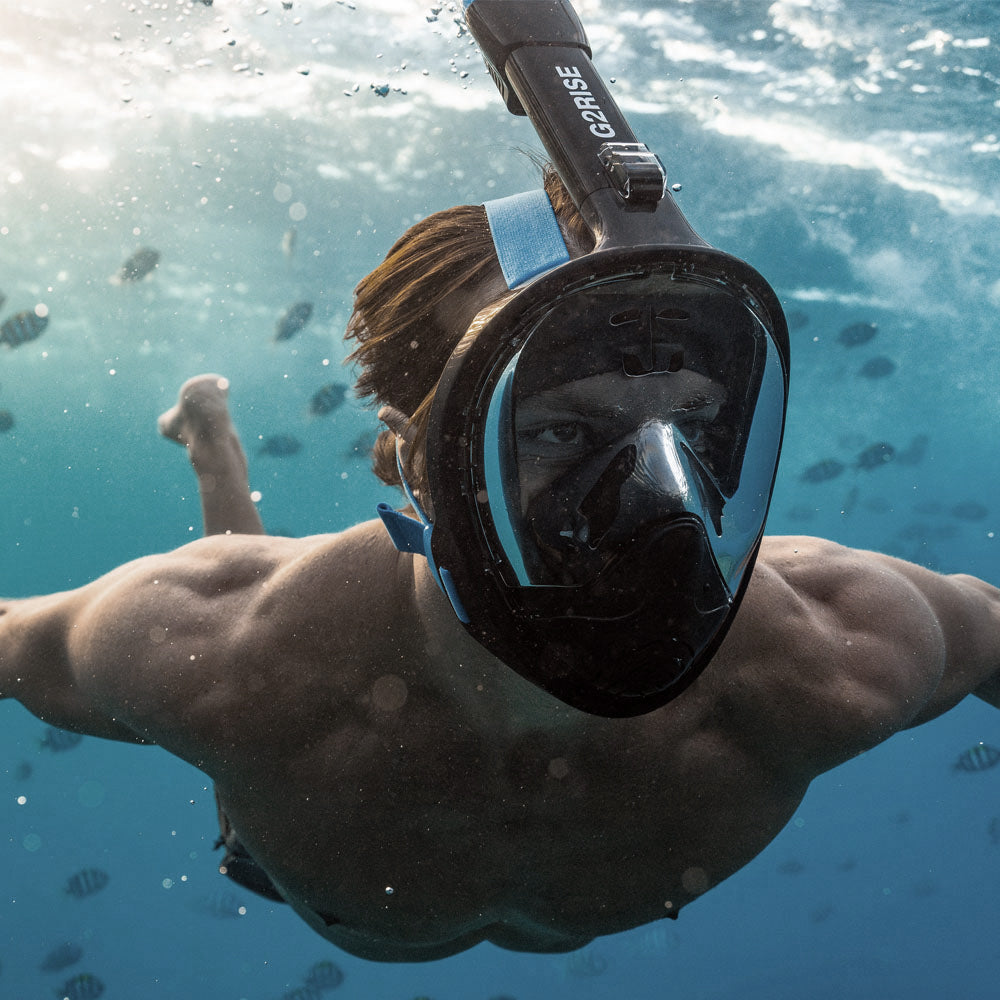
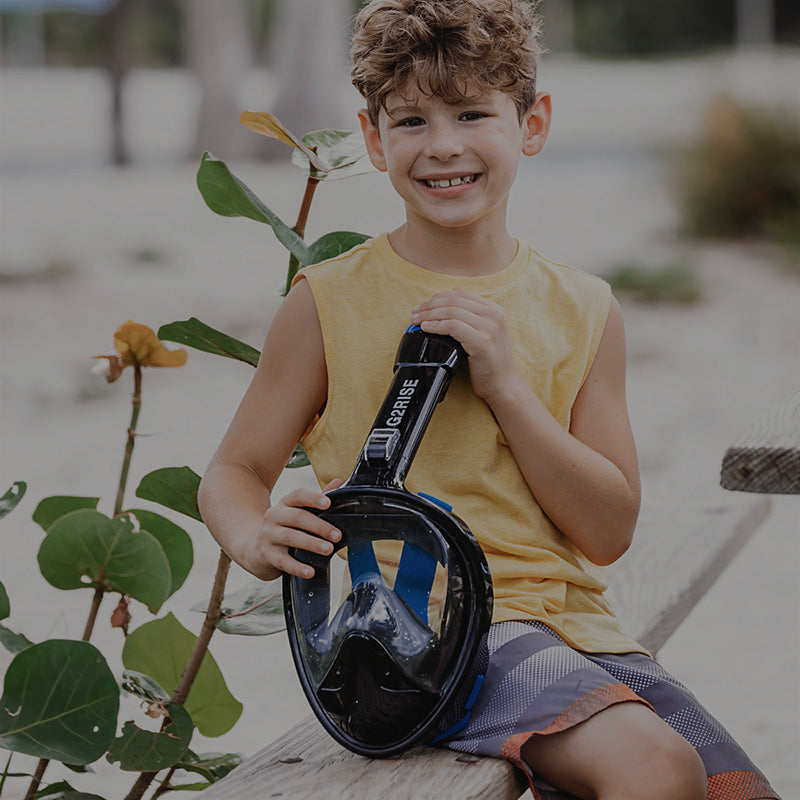
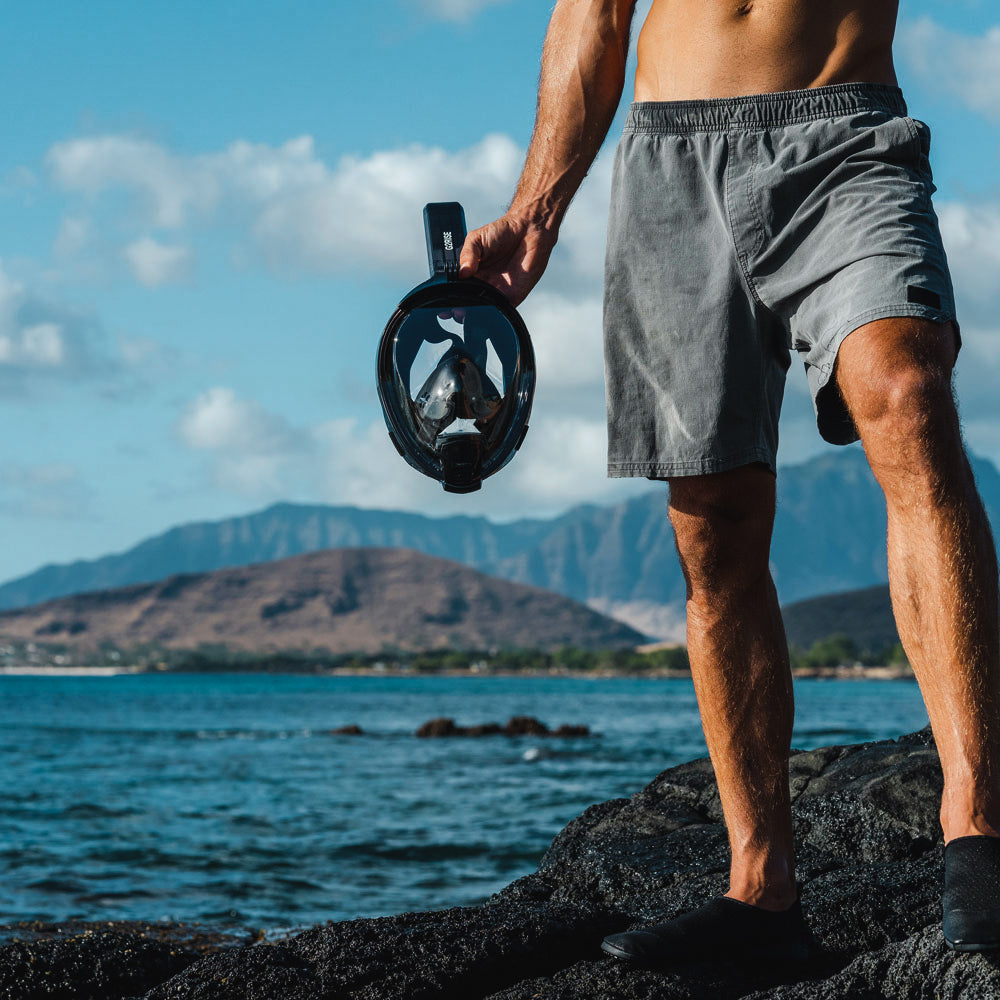
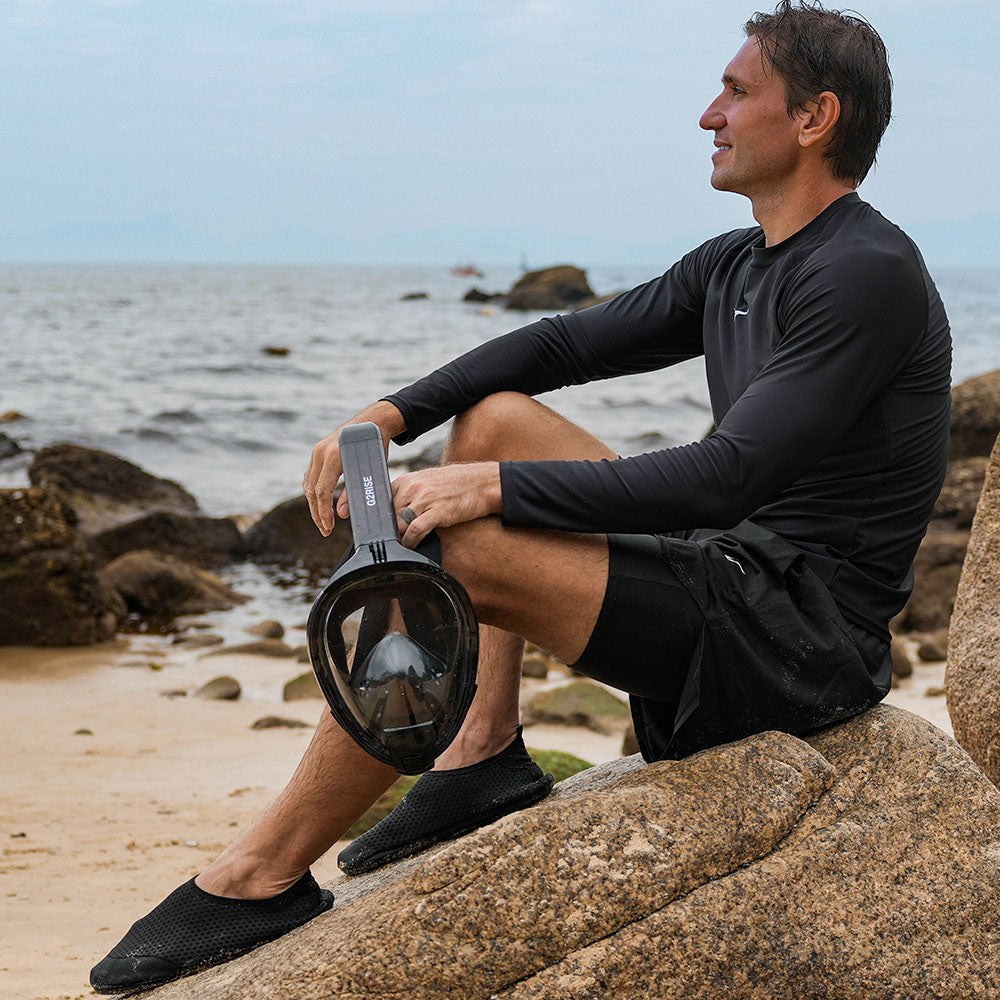
G2RISE's SN01 uses a dual-layer soft silicone skirt designed to maintain contact across varied facial structures. For contact lens wearers, the design goal is specifically that the mask stays sealed — the consequence of a leak is more significant for you than for non-wearers, and the mask specification reflects that priority. Combined with daily disposable lenses and the closed-eyes clearing protocol, it covers the contact wearer's snorkeling setup comprehensively.

Quick Reference: Contact Lens Snorkeling Checklist
- Use soft lenses only — daily disposables preferred
- Verify mask seal before entering the water (no-strap test)
- Close eyes immediately if water enters the mask
- Clear mask with eyes closed, exhale through nose
- Never rub eyes in or near the water
- Remove and dispose of daily lenses immediately after the session
- Disinfect reusable lenses with hydrogen peroxide solution, not multi-purpose solution alone
- Monitor for redness, light sensitivity, or unusual discomfort in the following 48 hours
- Bring a spare pair — losing a lens in the water is more common than it seems

Leave a comment
This site is protected by hCaptcha and the hCaptcha Privacy Policy and Terms of Service apply.