
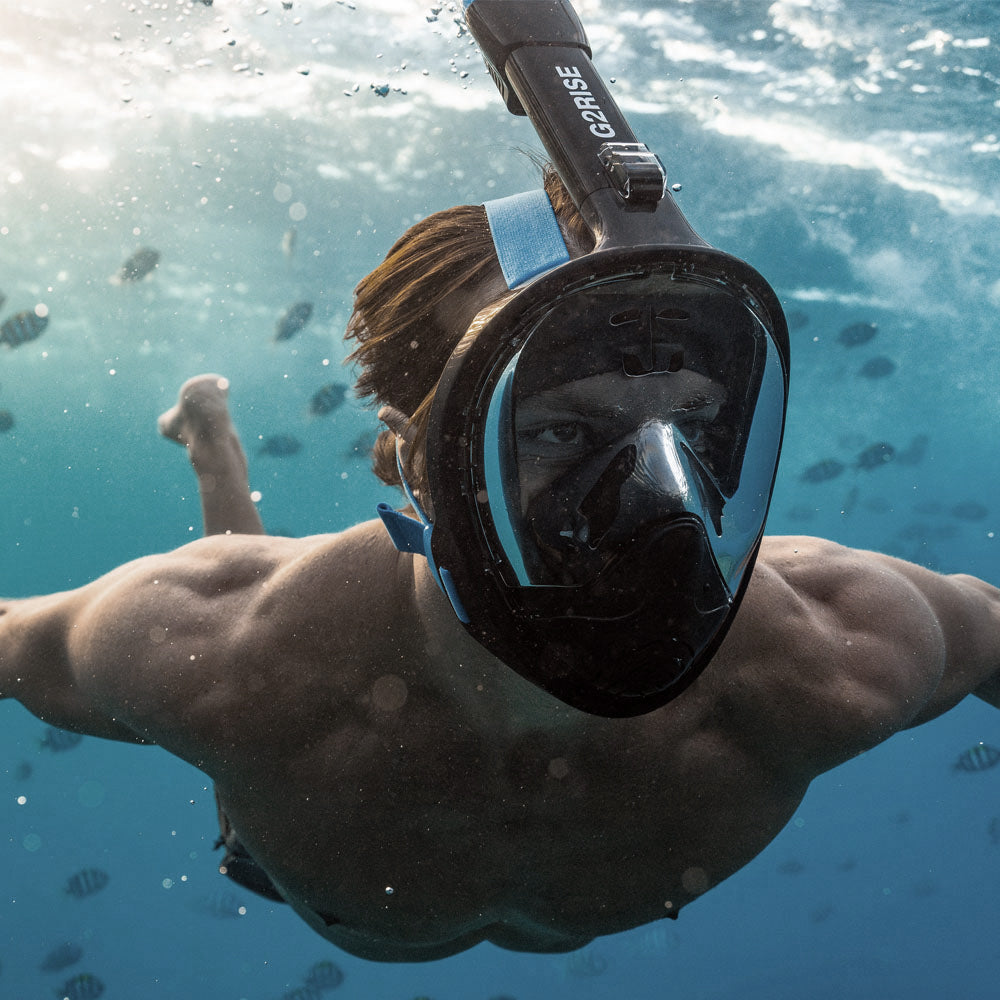

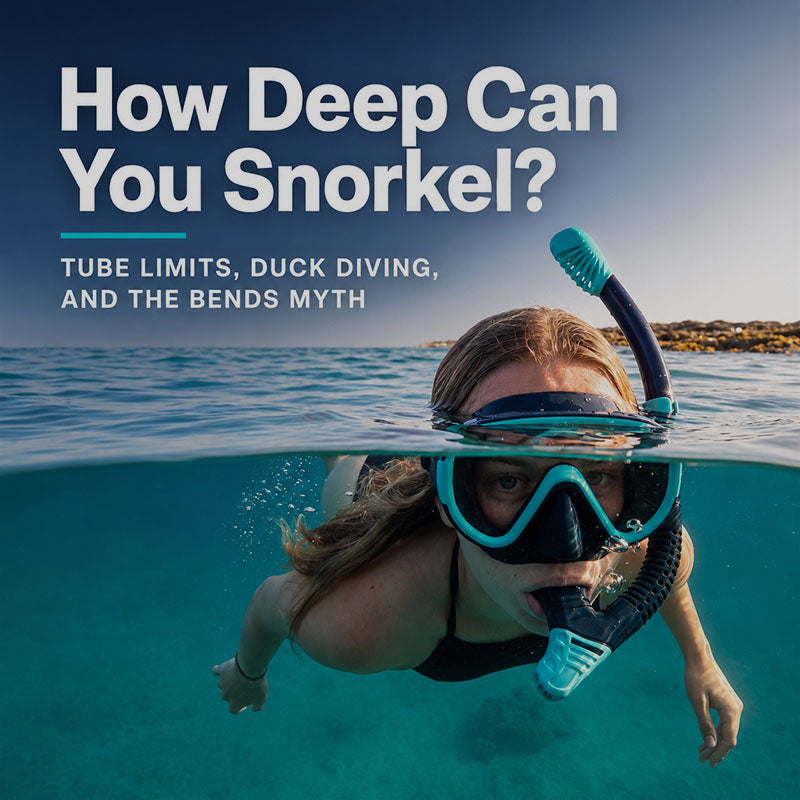
Most people searching "how deep can you snorkel" are actually asking two different questions without realizing it: how deep can a snorkel tube let you breathe while submerged, and how deep can you dive underwater while snorkeling? The answers are very different — about 30 to 40 centimeters (12 to 16 inches) for the first question, and potentially 10 meters or more for the second. Conflating them leads to confusion and, occasionally, real safety mistakes.

How Deep Can a Snorkel Tube Actually Let You Breathe?
The functional breathing limit of a snorkel tube is shallower than most people expect: roughly 30 to 40 centimeters (12 to 16 inches) below the surface. Beyond that depth, two separate physical mechanisms make it effectively impossible to breathe through the tube while your body is submerged.
The first mechanism is inspiratory resistance. As you descend, water pressure increases on your chest wall and lungs. Your breathing muscles — specifically the diaphragm and intercostal muscles — must work against that pressure to inflate the lungs. The deeper you go, the greater the pressure differential between your submerged chest and the air at the surface end of the tube. By the time your mouth is 30 to 40 centimeters below the water, inhaling against this resistance requires effort most people can't sustain for more than a breath or two.
The second mechanism is CO2 accumulation from dead space. Every breath you exhale partially fills the snorkel tube with CO2-rich air. Your next inhalation draws some of that stale air back into your lungs before reaching the fresh air at the surface. This is called rebreathing. Standard snorkel tubes are sized to keep dead space manageable at the surface, where you can breathe rapidly enough to stay ahead of the CO2 buildup. Submerge even slightly, and the combination of restricted airflow and dead space causes CO2 to accumulate faster than you can clear it, leading to dizziness and the urge to breathe faster — which makes things worse, not better.
For these reasons, snorkeling is fundamentally a surface activity. The snorkel tube functions correctly when your face is in the water and your head floats at or very near the surface. It is not designed for, and does not function for, underwater breathing at any meaningful depth.
Can You Get Decompression Sickness ("The Bends") from Snorkeling?
No — and this claim appears often enough in snorkeling content that it's worth addressing directly. Decompression sickness (DCS), commonly called "the bends," occurs when dissolved nitrogen in the blood and tissues forms bubbles as pressure decreases too rapidly during ascent. It requires breathing compressed air or other gas mixtures at depth — which is what scuba divers do — so that tissues absorb nitrogen under pressure.
Snorkelers hold their breath when diving below the surface. Breath-hold divers breathe no compressed gas at depth, so their tissues don't absorb excess nitrogen, and there is no mechanism by which decompression sickness can develop. Competitive freediving athletes regularly dive to 30, 40, even 50 meters repeatedly in a single session without any risk of DCS.
The breath-hold risks that are real for snorkelers are entirely different: shallow water blackout (hypoxic loss of consciousness from hyperventilating before a breath-hold dive), barotrauma to the ears or sinuses if equalization is skipped or rushed, and muscle fatigue or cramping in cold water. These are worth understanding, but they are distinct from decompression sickness.

How Deep Can You Actually Dive While Snorkeling?
The answer here depends on the person, not the equipment. When snorkelers "duck dive" — removing the tube from their mouth, taking a breath, and descending below the surface while holding their breath — they're doing a form of breath-hold diving. The depth achievable depends entirely on:
- Breath-hold capacity. Most recreational snorkelers can hold their breath for 30 to 60 seconds on the surface. In the water, physical exertion shortens that significantly. Beginners typically reach 2 to 3 meters before needing to surface. With practice and relaxation, recreational snorkelers often reach 5 to 8 meters. Trained breath-hold divers exceed 10 meters routinely.
- Ear equalization. Below 1.5 to 2 meters, most people feel ear pressure. To continue descending comfortably, you need to equalize — pinching your nose closed and gently blowing as if clearing your ears on an airplane (the Valsalva maneuver). If you can't equalize, discomfort and potential ear injury set the depth limit, not your breath capacity.
- Body position and technique. A duck dive should be smooth: submerge face-first, sweep your arms downward, lift your fins straight up out of the water so their weight drives you down, then glide. Thrashing or kicking immediately burns oxygen and cuts your bottom time.
A typical recreational snorkeler, following correct technique, can comfortably duck dive to 3 to 5 meters. This is also where much of the interesting marine life is — deeper coral structures, larger fish, things that don't appear in the top meter of water.
What About Full-Face Snorkel Masks at Depth?
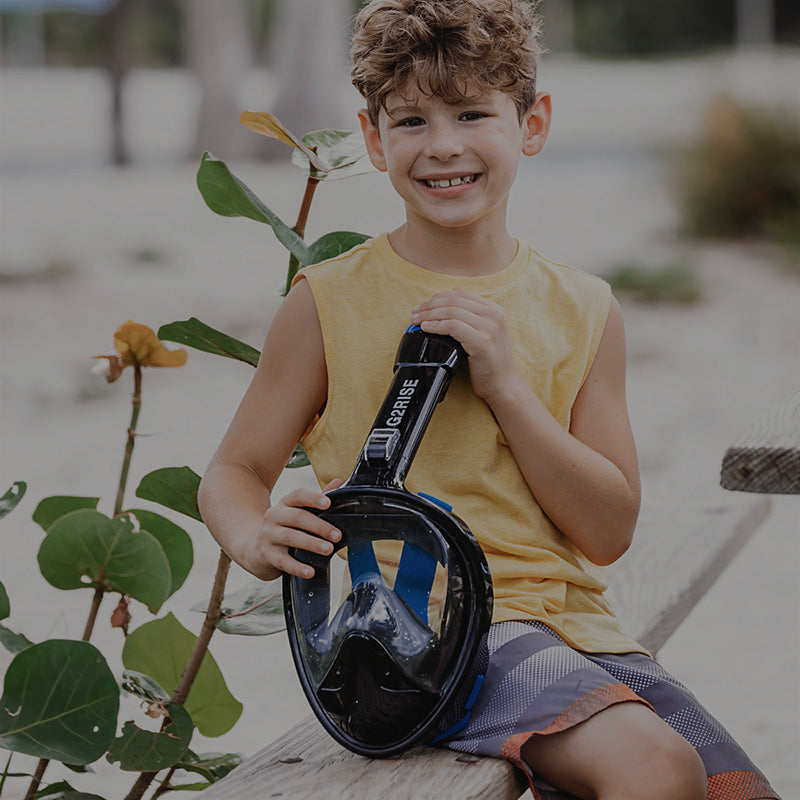
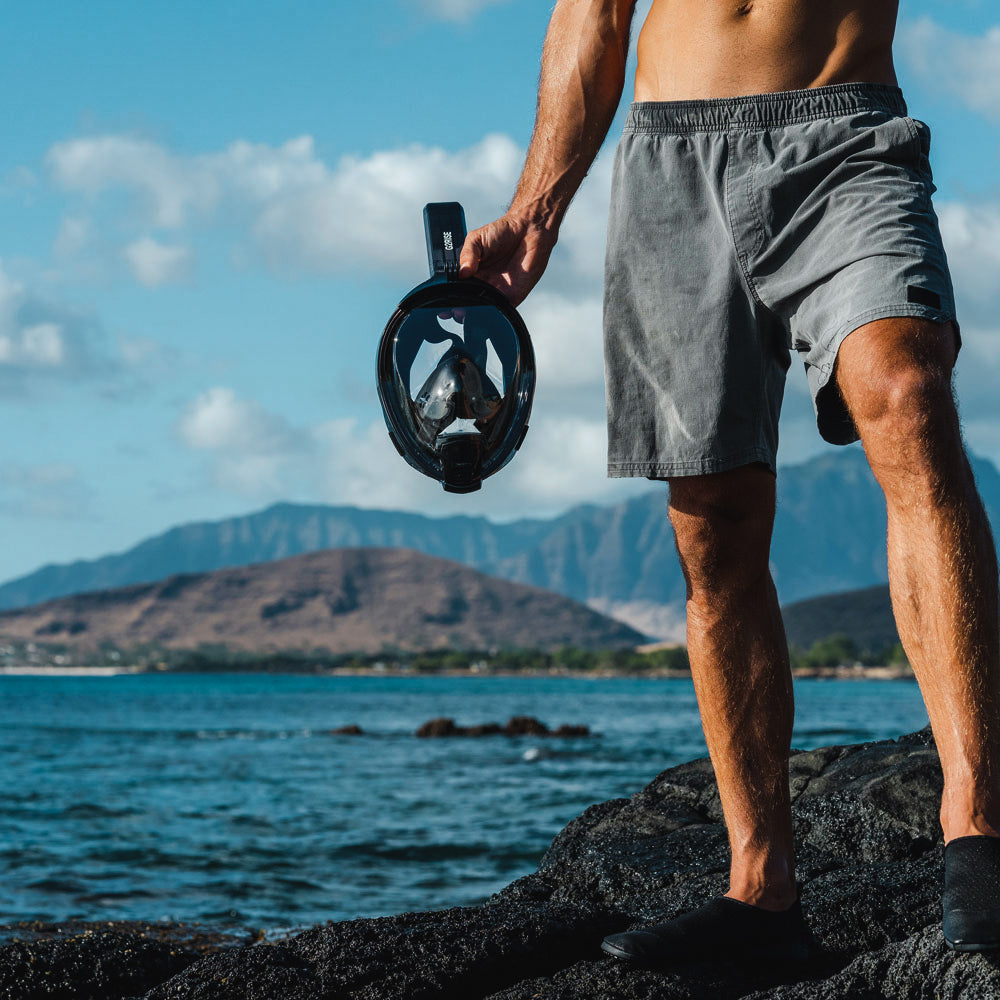
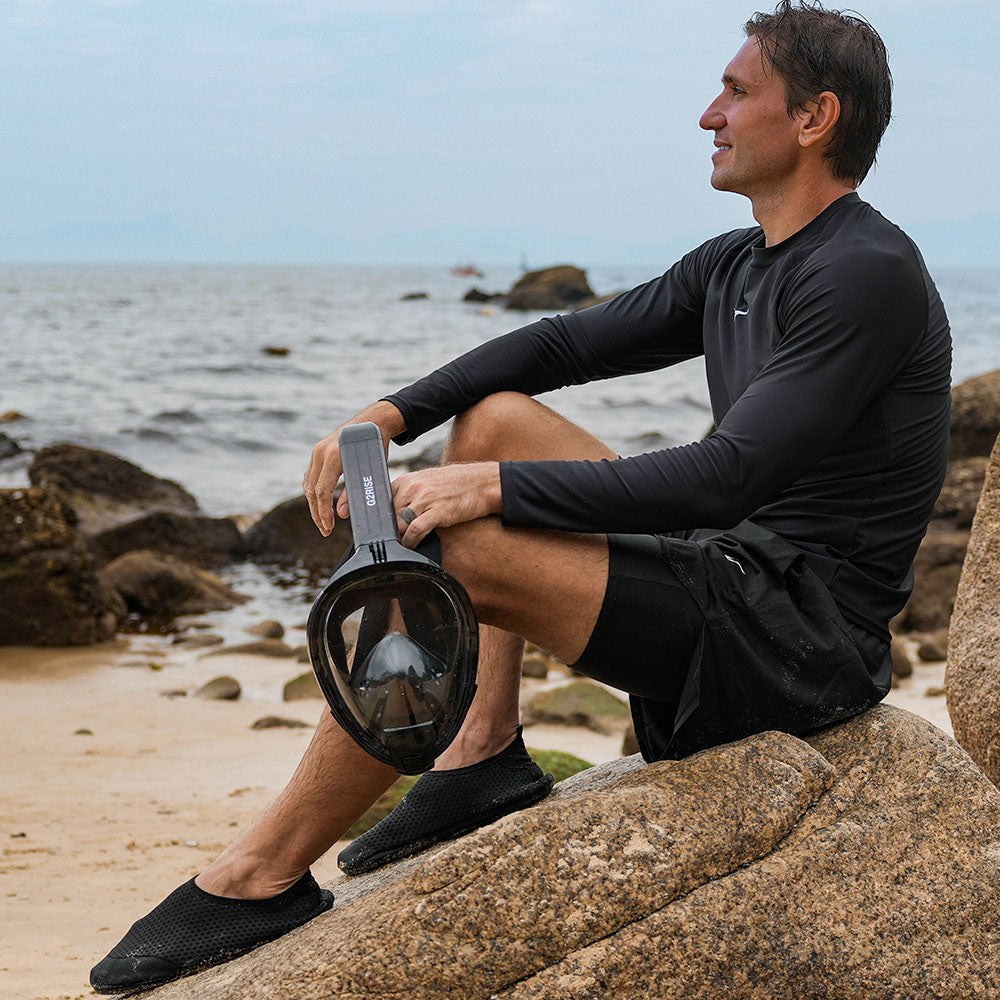
Full-face snorkel masks deserve separate treatment here because their relationship with depth is worse than a traditional snorkel — not better, as some marketing implies.
A traditional snorkel tube has a dead space of perhaps 150 to 200 ml. A full-face mask enclosing the entire face has a dead space of 600 ml or more — the entire mask cavity. At the surface with gentle breathing, ventilation designs in quality full-face masks manage this volume. The problem starts when the breathing rate increases (from exertion, from surprise, from mild anxiety) or when the mask is used in conditions that weren't tested by the manufacturer. CO2 can accumulate in the mask volume faster than it can be exhausted through the dry-top snorkel mechanism.
At depth, the problem is compounded: air pressure inside the mask must drop to match the increasing ambient pressure for the seal to hold, which affects airflow dynamics. The U.S. Consumer Product Safety Commission (CPSC) issued a warning specifically about certain full-face snorkel masks causing breathing difficulties, loss of consciousness, and drowning. Regardless of brand quality, full-face masks are not appropriate for duck diving below 1 to 1.5 meters — the CO2 accumulation risk is real at the lower effort levels typical of deeper breath-hold dives. For anyone planning to go below the surface, a traditional two-piece mask and snorkel is the appropriate equipment.
How Do You Duck Dive Correctly and Safely?
Duck diving is a skill, not just a natural action. The correct technique:
- Take a full, relaxed breath at the surface. Not a hyperventilated breath — just a comfortable, deep inhale. Hyperventilating before a breath-hold dive suppresses your urge to breathe without actually increasing oxygen stores, which is dangerous.
- Remove the snorkel mouthpiece. You won't be using it underwater.
- Bend at the waist to point straight down. Arms leading, sweep them forward and down as you submerge your upper body.
- Lift your legs and fins straight up. Their weight acts as a natural anchor that drives you downward without effort. Many beginners kick immediately, burning oxygen unnecessarily — let the fins do the work.
- Equalize at 1.5 meters. Pinch your nose through the mask nose pocket and exhale gently through your nose. If you can't equalize, stop descending and come up rather than forcing it.
- Surface with energy in reserve. The urge to breathe comes from CO2 buildup, not lack of oxygen. Your body will give you an involuntary signal to surface — don't ignore it. Always surface with comfortable margin before you feel desperate to breathe.
- Clear the snorkel at the surface before inhaling. A sharp exhale through the tube blows any water out. Then breathe normally for 2 to 3 minutes before diving again.
What Depth Has the Best Snorkeling?
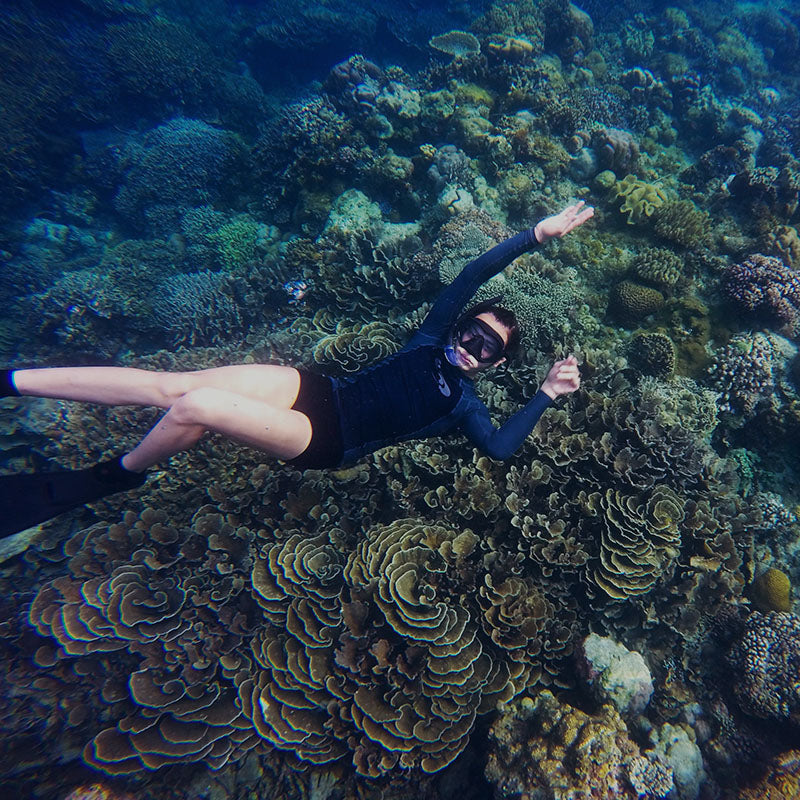
The counterintuitive answer: most of the best snorkeling is in the top 3 meters. Coral reefs grow toward the sunlight. Reef fish live where the coral is. Tropical marine environments in their most vibrant form — dense branching coral, large schools of fish, cleaning stations where fish interact with larger animals — are all concentrated in the 0 to 4 meter range accessible to recreational snorkelers without advanced breath-hold skills.
Deeper water doesn't necessarily mean better wildlife encounters. It means bigger animals (pelagic fish, larger rays, sharks) that patrol open water rather than reef structures. For most recreational snorkelers, the most productive approach is to become excellent at surface snorkeling — very slow drift, minimal movement, patient observation — rather than trying to maximize depth. The animals come to the surface; you don't need to go deep to find them.
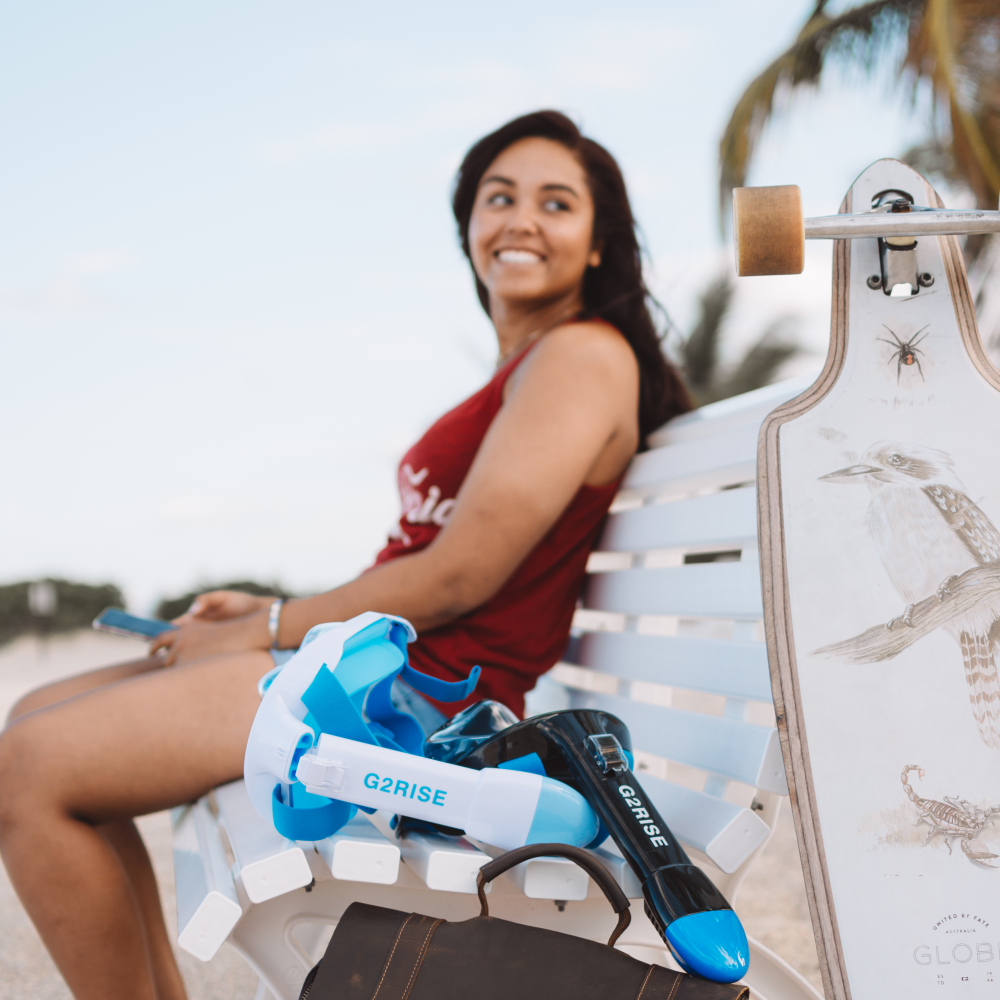
A well-fitted mask, a dry-top snorkel that prevents water ingestion, and the patience to float quietly will produce better encounters than any amount of duck-diving skill. G2RISE's SN01 mask and snorkel is designed around surface snorkeling: a dual-layer silicone seal that maintains water-out performance when you keep your face in the water for extended observation, and a snorkel with internal baffle and purge valve to make clearing any intruded water automatic. For recreational depth — the 2 to 4 meter duck dives that let you get closer to the reef — the traditional mask-and-snorkel combination used correctly is what you want.

Quick Reference: Snorkeling Depth Realities
- Breathing through a snorkel tube while submerged: practical limit is 30–40 cm (12–16 in)
- Duck diving while holding your breath: beginners typically reach 2–3 m; recreational snorkelers with practice, 5–8 m
- Full-face mask safe depth limit: 1–1.5 m maximum due to CO2 accumulation risk
- Ear equalization required: typically at 1.5–2 m depth
- Decompression sickness from snorkeling: not possible without compressed gas
- Best marine life depth range: 0–3 m, concentrated in reef structures

Leave a comment
This site is protected by hCaptcha and the hCaptcha Privacy Policy and Terms of Service apply.