

Fins are the most safety-critical piece of snorkel gear most people underestimate. Without them, a mild current that a finned snorkeler handles easily becomes an exhausting swim against the water. With the wrong pair — too short, too stiff, or poorly fitted — you spend your energy fighting the equipment instead of watching the reef. This guide covers how to choose fins that match how and where you actually snorkel, including a sizing trap that catches most women buyers.

Why Do You Actually Need Fins for Snorkeling?
Fins aren't about speed. They're about efficiency and, more importantly, reserve capacity. In flat, still water you can snorkel without fins. In open ocean conditions with any current — even a mild one — bare feet give you almost no ability to hold position or return to the boat. Fins multiply the power of each kick dramatically, letting you cover ground with minimal effort so you arrive at the reef with energy remaining rather than half-spent from the swim out.
The safety argument is the one most guides skip: fins are a rescue tool. When you or someone near you encounters an unexpected current, a rip, or fatigue, fins are the difference between swimming back comfortably and struggling. Experienced snorkeling guides universally wear fins, not for speed but because they refuse to be in the ocean without that power reserve. That reasoning applies equally to recreational snorkelers.
Should You Get Full Foot or Open Heel Snorkeling Fins?
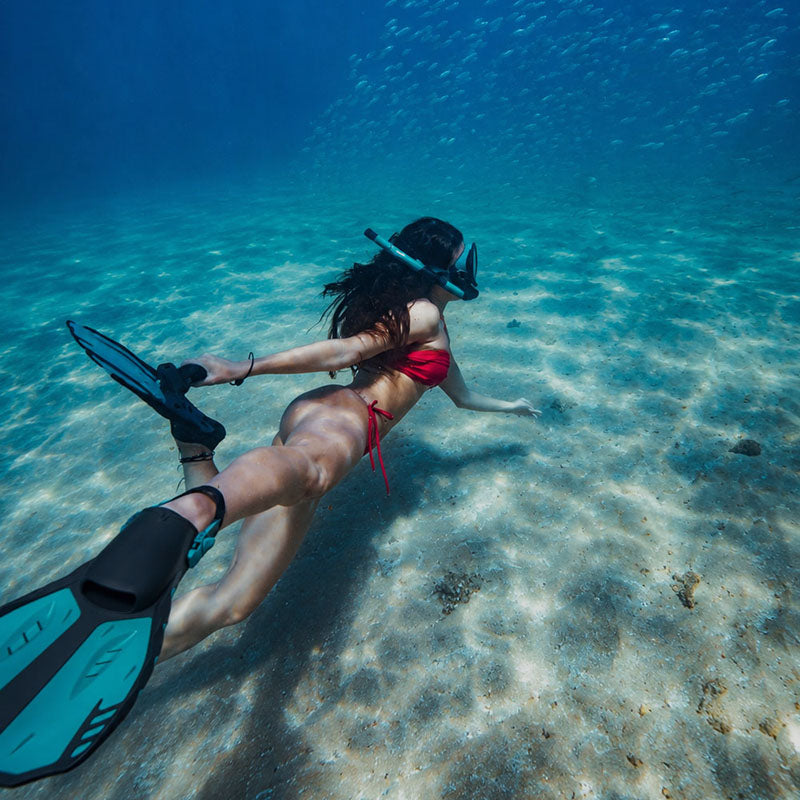
Full foot fins enclose the entire foot, worn either barefoot or with thin Lycra socks. Open heel fins have an adjustable strap across the back of the heel, and come in two variations: barefoot versions, and versions designed to be worn with neoprene boots.
The right choice depends almost entirely on where you enter the water. If you snorkel from a boat, pier, or sandy beach, full foot fins are the better choice. They're lighter, more hydrodynamic, and put less fatigue on your legs over a long session because you're not moving extra weight and bulk with every kick. Most experienced snorkel guides who spend 200+ days a year in the water use full foot fins for exactly this reason.
If your snorkeling involves rocky shore entries — walking across uneven terrain before you can swim — open heel fins worn with neoprene boots solve a real problem. You walk in your boots, enter the water, put the fins on once you're floating, and don't have to carry or strap your footwear to a belt. The trade-off is bulk, weight, and the challenge of finding a boot-fin combination that doesn't rub raw spots when you kick for an hour.
The barefoot open heel design (strap, no boot) sits in between — shorter than full foot fins for travel packing, but with your heel exposed and the strap prone to slipping if not fitted carefully.

What Fin Length Is Right for Snorkeling?
Medium-length fins are the right choice for surface snorkeling, and the logic for avoiding both extremes is worth understanding rather than just accepting.
Short fins — compact travel fins, bodyboard fins, fitness swim fins — have genuinely limited propulsion. They're easy to kick because there's not much blade to move, but that same lack of blade means little water is displaced per kick. In calm conditions they're manageable. Against any current, you'll be kicking at a pace that exhausts you while covering ground slowly. Guides who have watched guests struggle with short fins in moderate conditions consistently report the same thing: the people with short fins are always the ones bringing up the rear, working harder than everyone else to go less distance.
Very long fins — freediving fins with 60+ cm blades — are designed for a specific purpose: long, slow, efficient kicks while descending vertically. On the surface, they're unwieldy. Maneuvering around coral, adjusting direction quickly, or kicking in shallow conditions all become difficult. They're also a travel nightmare.
Medium snorkeling fins, typically 40–55 cm, hit the right balance: enough blade to move water efficiently, short enough to maneuver and pack into checked luggage. Think of it like bike gears on flat ground — you don't want the lowest gear (short fins) or the highest (long freediving blades), you want the mid-range that lets you cruise efficiently while still having power when you need it.
How Stiff Should Snorkeling Fins Be?
This is the most nuanced question in fin selection, and most guides give you a non-answer. Here's what actually determines the right stiffness: the match between fin resistance and your leg strength.
It's counterintuitive, but a stiffer fin is not automatically more powerful. A stiff fin requires significant force to flex it through a full kick cycle. If your leg muscles aren't large enough to efficiently move that stiffness, you lose propulsion — the fin doesn't complete its full flex, the kick is incomplete, and you end up working harder for less result. It's like being in too high a gear on a bicycle going uphill: technically the gear ratio is favorable, but if you can't maintain cadence, you go slower and tire faster.
Lighter, smaller-framed snorkelers — particularly those who don't train their legs regularly — get better performance from flexible fins. Larger, stronger snorkelers or anyone with serious leg development can take advantage of a stiffer blade's greater power output per kick.
The practical test is to try fins in the water if possible. A fin that feels responsive and effortless in a 30-minute session is the right stiffness for you, regardless of what the spec sheet says.
What Are Split Fins and Hinged Fins — Are They Worth It?
Split fins have a slot running down the center of the blade, dividing it in two. The rationale offered by manufacturers is that the two sections generate propulsion more efficiently. The counter-argument from experienced guides is that you're creating gaps in the blade — the primary tool for pushing water — which reduces overall thrust. It's a design tradeoff that the marketing describes as an advantage, but the practical consensus among professional snorkelers is that a solid blade of equivalent size provides more usable propulsion.
Hinged and articulated designs add a pivot point or rubber hinge to the fin, theoretically allowing it to "power stroke" more naturally. The engineering logic has some merit, but the hinge point is also a vulnerability — the precise location where fins eventually break after repeated stress cycles, leaving you with rental fins for the rest of the trip.
For most recreational snorkelers, a simple solid-blade fin with good flex in the right zones outperforms the engineered alternatives. The best fin is the one with the most straightforward design that fits your foot and matches your strength — not the one with the most features.

How Do You Size Snorkeling Fins? (Including the Women's Sizing Trap)
Fin sizing has a significant, rarely-mentioned catch: virtually all snorkeling fins are sized in men's measurements. If you're a woman buying fins, you typically need to subtract 1.5 to 2 US sizes from your regular shoe size to get the correct fin size. European (EU) sizing is unisex and avoids this confusion entirely — if a fin is available in EU sizes, use those.
The general fit principle: fins should be snug but not painful. Your feet shrink slightly in cold water, which means a fit that feels just right on land will be slightly looser in the ocean. Going one size tighter than feels natural on land is usually correct. A loose heel cup or strap that lets your foot slide is one of the most annoying things that can happen in the water — you lose propulsion efficiency and can't kick with confidence.
When trying fins in a shop, point your foot and simulate a kicking motion. If the fin presses hard against a bone, rubs over a bunion, or pinches anywhere, it will be far worse after hundreds of repeated kicks. Pay particular attention to hard plastic side rails — softer rubber on the foot pocket perimeter is far more forgiving over a long session.
If you're wearing boots with open heel fins, buy the boots first and size your fins over them. Some combinations that feel fine when walking develop severe rub points in the extended pointed-foot position of kicking. Waterproof bandages and toe tape are worth packing regardless — moderate redness is normal when you haven't snorkeled recently, but open blisters are both painful and a potential infection point in ocean water.
How Do You Use Snorkeling Fins Correctly?
The correct snorkeling kick is a long, smooth sweep from the hip — not a bent-knee flutter kick as if you're swimming freestyle. In the flutter kick, you're flexing at the knee repeatedly, which bends the fin rather than propelling it. In the hip-driven kick, your entire leg moves as one unit, and the fin flexes at the appropriate point at the end of the stroke, converting your leg movement into forward thrust.
Keep your fins below the surface. Lifting them out of the water on every kick, which many beginners do, means the power stroke only moves air. Keep the kick amplitude just large enough to keep both fins fully submerged, and focus on the smoothness of the motion rather than speed or force. Relaxed, rhythmic kicking over 45 minutes beats frantic splashing that exhausts you in 15.
Arms: experienced snorkelers largely keep their arms at their sides or folded behind their back. Arm movement in snorkeling is mostly counterproductive — it adds turbulence, creates drag, and tires your shoulders without contributing meaningfully to forward movement. Your fins are doing the work; let them.
What Should You Avoid When Buying Snorkeling Fins?
The three most common fin purchase mistakes, in order of frequency:
Buying short travel fins to save luggage space. Medium fins do fit in standard 22-inch carry-on bags for many foot sizes. The propulsion loss with short fins is real enough to matter when it actually counts — in unexpected current. The inconvenience of packing slightly larger fins is a much smaller problem than being underpowered in an ocean situation.
Buying stiff fins because they "look powerful." If the fin is too stiff for your body to flex through a full kick cycle, you're getting neither power nor efficiency. As noted above, the right stiffness depends on your strength, not on maximizing the spec.
Ignoring women's sizing and buying based on shoe size alone. The subtraction of 1.5-2 US sizes is a real adjustment, not a small rounding error. Fins that are too large don't hold on your foot reliably and the unbuckled heel strap problem is exactly as irritating as it sounds.
G2RISE's SN01 fin set is built around medium-length, medium-flex blades with a full-foot silicone pocket designed for extended wear comfort. The sizing runs true to EU sizing (unisex), which sidesteps the men's/women's conversion issue entirely. For a first pair of snorkeling fins or a replacement set you'll actually want to pack, the combination of travel-friendly length and flexible blade makes them a practical default for recreational use across most conditions.

A Note on Long-Term Fin Care
Fins are low-maintenance gear, but a few habits extend their life significantly. Rinse with fresh water after every saltwater session — salt crystallization in the rubber foot pocket causes cracking over time. Store flat or hung, not resting on the blade tips; sustained pressure on the fin tips can cause the blade material to separate at the edge where rubber meets plastic. Keep out of direct UV sunlight during storage — extended sun exposure degrades rubber and silicone faster than any amount of normal use.
A well-cared-for pair of quality fins should last 5 to 10 years of regular recreational use. The economics of owning versus renting make even a moderately priced pair pay off within two or three trips.



Leave a comment
This site is protected by hCaptcha and the hCaptcha Privacy Policy and Terms of Service apply.